Power of Ten mechanics: the order every result is settled in
This slot settles a round in four stages, and it always settles them in the same order. Lines, then wheels, then addition, then the stake. Each stage is described below in the terms the studio's own feature copy uses, and where that copy is silent the silence is stated rather than filled.
The order is not decoration. It is the reason a round with two wheels on it produces one feature result rather than two payments, and the reason a figure quoted as money rather than as a multiple is a figure that has already lost information.
| 1 — lines | ordinary payline awards are handled |
|---|---|
| 2 — wheels | every landed wheel spins and reveals |
| 3 — addition | revealed values are added to each other |
| 4 — stake | the sum is multiplied by the current bet |
| Interrupt | top result reaches 10,000x and ends the round |
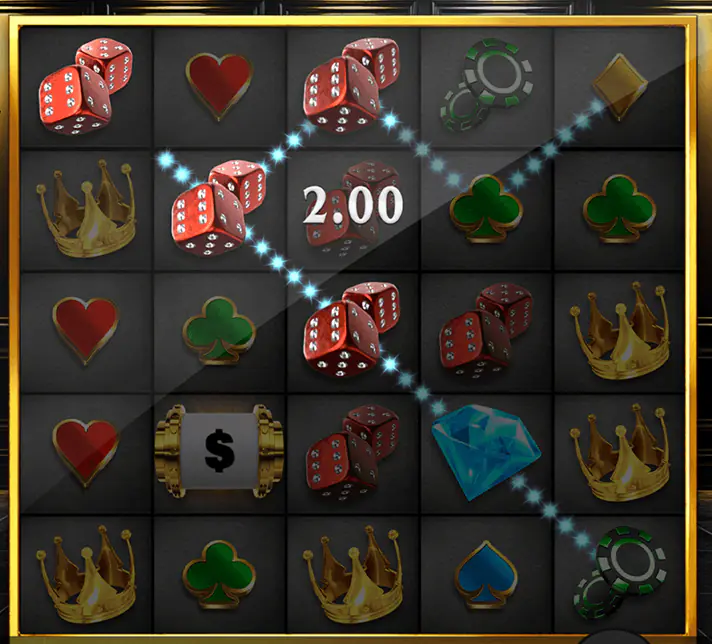 Stage one, caught in the studio's own still: a line is lit and its award is displayed over the grid. The win counter in the bar underneath is a different number in a different place, which is the distinction this page is about.
Stage one: the lines, and only the lines
A spin resolves its ordinary combinations before anything else is allowed to happen. The studio's rule for the wheel symbol is explicit about the dependency: a wheel that has landed stays inactive until all payline wins have been handled. That is the whole of stage one, and it is also the only stage in which the ordinary symbols matter.
Our source describes five reels and leaves the rest of the board unstated. Large listings fill the gap with five reels and five rows and 19 fixed lines reading left to right, and the studio's own screen capture shows exactly that grid: five columns, five rows, with one line lit across it. So the figure is a listing's and the picture is the studio's, and they agree.
The same listings set out a paytable in bands rather than in cash — a top symbol running from five times the stake up to fifty, two middle bands, and the card suits at the bottom from a fifth of the stake up to three times it. That belongs to stage one too. None of it is on our source, and it is quoted here as theirs.
Stage two: the symbol that was waiting
Once the lines are finished, each wheel on the grid becomes active and spins. It reveals one of 10x, 100x, 1,000x or MAX WIN. Nothing about that reveal depends on what the lines did; the dependency runs the other way, and it is a dependency of timing rather than of value.
The reason to separate the two stages at all is legibility. A feature award landing in the middle of a line animation would be read as part of the line, and on a game whose feature values are two and three orders of magnitude above its line values that misreading would be expensive to the reader's understanding of what just happened.
Stage three: values add before anything is multiplied
When more than one wheel is in view, the values on the wheels are added together. The wording in the studio's copy is unusually precise here: the total sum of the amount on the wheels is then multiplied with the current bet, resulting in the definitive win. Addition first, multiplication second, one result.
That sentence is the hinge of the whole game. Four wheels showing a hundred times the stake each do not produce four awards; they produce one award of four hundred times the stake. It also means the game can show each wheel's value and a single total without contradicting itself, because the two are different things at different points in the same calculation.
A filled row changes one list, not the rule
Five wheels on the same row use a stronger table on every position: 100x, 1,000x or MAX WIN, with the shortest standard value removed. That is the only change. The row still settles after the lines, its wheels still add to one another, and the stake still arrives once at the end.
It is worth being precise about what a filled row is and is not. It is not a separate prize for completing the row. It raises the floor of what each of the five positions can show, which changes the distribution of the sum rather than adding a bonus to it.
Where the stake enters, and where it does not
The stake multiplies the sum of the wheel values, once, after the addition. It does not multiply each wheel separately, it does not scale the line awards a second time, and it does not appear anywhere in the published rules as something that changes which values a wheel can show. Listings record a range running from 0.10 to 100 per spin; that range decides what the final figure is worth and nothing about how it is arrived at.
This is the one place where a reader is likely to want a rule of thumb and where none exists. The multiples are the same at every stake in the range, which is precisely why there is nothing to choose between them arithmetically. Anything written as though a particular bet level changes the model has stepped outside what the studio published.
The result that stops the arithmetic
One outcome ends the sequence instead of continuing it. If a wheel reveals the top result, the maximum win is awarded immediately and the round ends — the studio's own words. The 10,000x ceiling is reached at that moment and nothing further is added, because the round that would have added it is over.
That makes the top result categorically different from the other three. The first three are quantities that join a sum. The fourth is a terminal state. A round cannot reach the ceiling by accumulation and then continue past it, and it cannot reach it twice.
What the wild touches
The wild substitutes for every symbol in the paytable, and that is the whole of its job. It lives in stage one, helping lines qualify, and it has no part in the wheel stage, the addition or the final multiplication. Listings add that five wilds on a line pay fifty times the stake, which is a stage-one figure like any other and is theirs rather than ours.
Keeping the special symbols on separate jobs is what makes a feature-heavy game readable at a glance. Wheels carry prizes, arrows build rows in a round of their own, scatters choose which rule set applies, and the wild does none of those three. Hacksaw Gaming gives each of them exactly one function, and no symbol here has a second meaning depending on where it lands.
Questions about the result order
Why does a wheel wait instead of paying when it lands?
Because the studio's rule says it stays inactive until all payline wins have been handled. Holding it back keeps the symbol award and the feature award as two readable stages instead of one blur, and it is what makes the addition step below possible.
At which point does the stake enter the sum?
Once, at the end. The wheel values are added to each other first, and the total is then multiplied by the current bet. Nothing is converted into money before that multiplication.
Does a five-wheel row change the order?
No. It changes one list and nothing else: each wheel in a filled row uses 100x, 1,000x or MAX WIN instead of the standard four. Lines still settle first, the wheels still add, and the stake still arrives last.
What does the wild do in this sequence?
It substitutes for every symbol in the paytable, which means it belongs entirely to the first stage. A wild helps a line qualify; it does not reach the wheel stage, does not carry a prize table of its own in that stage and does not touch the addition.
Is there anything that stops the sequence early?
Yes, exactly one thing. A wheel revealing the top result awards the 10,000x ceiling immediately and the round ends. Nothing is added to it afterwards, because there is no afterwards.
Can the order of these stages be changed from the controls?
No. The sequence is part of how the game settles a round and there is no control, stake level or setting that reorders it. Changing the stake changes what the final multiplication produces and nothing else about the arithmetic.
Carry on with
What each of those multiples is multiplied by, and the four return builds behind the single percentage everyone quotes, are on the multiples page. The round that abandons this sequence entirely is the arrow round, and the three entries that change which rule applies are on the scatter counts page. The opening page has the same sequence in four lines.