Power of Ten FeatureSpins: a row survives, or it is finished
One round in this game does not add anything up. The High-Roller FeatureSpins strip the grid of every ordinary symbol, deal a shrinking number of arrows across the five reels, and settle on a single question: is any horizontal row still covered from the first column to the last.
That makes it the only part of the game that is not arithmetic in the sense the rest of these pages use. There is no sum, no addition, no scaling of several values — there is a condition, and it is either met or it is not.
| Symbols on the grid | the arrow, and nothing else |
|---|---|
| Arrows per reel | five, four, three, two and one, reels one to five |
| A row ends when | any one of its five positions is left empty |
| Result if a row survives | 10,000x the stake |
| Result if none does | nothing — there is no partial award |
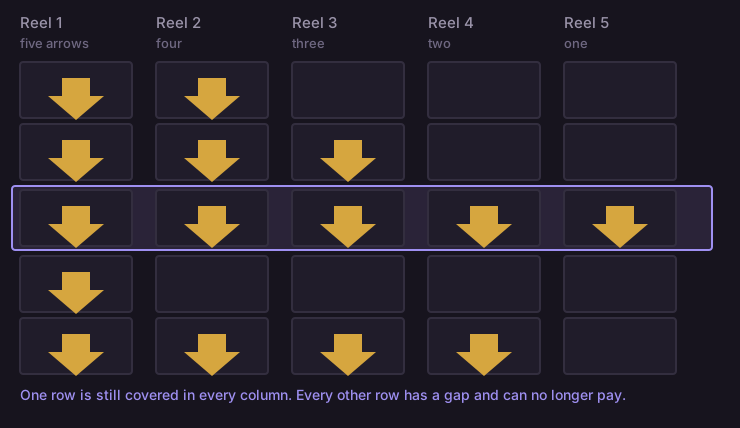 Drawn here from the counts the studio's copy gives, not taken from the game. It shows why the last column decides everything: by then only one position is being placed, and it either lands on a row that is still intact or it does not.
A grid with one symbol on it
During the High-Roller FeatureSpins only arrow symbols can land. Everything else that normally occupies the board is absent for the duration: the suits, the dice, the chips, the crowns, the diamonds, the wild, and the wheels that the rest of this game is built around. What is left is a grid of filled and empty positions.
Stripping the board that far is what makes the round readable without any interface at all. There is no payline diagram to consult and no prize table to look up, because the only thing that can be read off the grid is whether a horizontal path is unbroken.
Five, four, three, two, one
The arrows are dealt across the reels in a shrinking count: five, four, three, two and one, from the first column to the fifth. The first column is covered completely, so every row starts the round alive. Each column after it places fewer arrows than positions, so each one is capable of ending at least one row.
By the fifth column a single arrow is being placed. Whatever has survived the first four columns has to include the row that last arrow lands on, or the round produces nothing. That is the entire structure, and it is why the tension of the round is front-loaded into a shape rather than spread across a sum.
How a row dies, and when
A row stays alive while every position along it holds an arrow. The moment one column leaves that row blank, the row is finished and cannot qualify later: there is no mechanism in the published rules by which a later column repairs an earlier gap.
Rows therefore die at different moments, and the board shows which ones have. This is the one place in the game where the grid is a status display rather than a prize layout — the arrows are not worth anything individually, and their only meaning is which paths they have kept open.
All or nothing is a different kind of accounting
Everywhere else in this game, several things contribute to one sum. Lines contribute, wheels contribute, wheels in a filled row contribute more. Here nothing contributes. A completed row awards the 10,000x ceiling; anything short of a completed row awards nothing at all, and four columns out of five is worth exactly as much as none.
The same ceiling can also be reached by a wheel revealing the top result in an ordinary round, which is worth noting because the two routes look nothing alike. One is a reveal that terminates a sum; the other is a spatial condition that was either met or was not. They end at the same figure and share no machinery.
Where this round is entered from, and at what price
Our source describes the round itself and not how it begins. Large listings fill that in: they record it as one of five entries that can be bought from a panel inside the game, priced at 3, 100, 200, 250 and 1,000 times the stake, with this round the most expensive of them. One of those listings notes that the panel may not be present at all in markets where such purchases are not permitted.
A price expressed as a multiple of the stake belongs to the same unit as every prize on this site — which is the only reason it is mentioned here. It is a fact about how the figures are denominated, not a suggestion about what to do with them, and nothing on this site recommends an entry, a price or a stake.
The one number that cannot be stated honestly
A reader reaching this page probably wants to know how often the row survives. The published material does not say. The studio's copy describes the deal and the condition and stops there.
Two outside figures circulate and they are not the same figure: one listing prints 1 in 10.39 and a separate site aimed at this game prints 1 in 13.33, both for the top result in this round. Neither names a source. Two incompatible numbers with nothing behind either is not a disagreement to split the difference on, so both are named here as somebody else's and neither is used.
It is also worth saying what would still be missing if one of them were confirmed. A figure for how often a result occurs says nothing whatever about whether it occurs in the next round, the next hundred or at all, and there is no element of this round — no control, no timing, no choice — that a reader could act on in any case.
Questions about the arrow round
Which symbols can land in this round?
Only the arrow symbol, on an otherwise empty grid. The ordinary suits, dice, chips, crowns and diamonds are gone, and so are the wheels, so none of the usual line arithmetic applies while the round runs.
How are the arrows dealt out?
five, four, three, two and one of them, across reels one to five in that order. The first column fills completely and each column after it places fewer than the one before.
What ends a row's chances?
One empty position anywhere along it. A row has to be covered in all five columns to pay at the end, so the first column that leaves it blank finishes it, and the remaining columns cannot bring it back.
What does a completed row award?
The published ceiling of 10,000x, and that is the only award in this round. There is no graded prize for four columns out of five, because there is no partial result at all.
Is this round the same thing as a wheel landing?
No. A wheel reveals a value that joins a sum. This round builds a pattern across the grid, and the pattern either reaches the far column intact or it does not. One is addition, the other is a condition.
What are the odds of the top result here?
Nothing published by the studio states them. One listing gives 1 in 10.39 and a separate site gives 1 in 13.33 for the same round, which is two incompatible figures with no agreed source behind either, so neither is repeated here as fact.
Carry on with
The ordinary sequence this round steps outside of is set out on the result order page, and the ceiling it shares with a wheel reveal is on the multiples page. The three entries that change which rule applies, including the one that holds a whole sum back, are on the scatter counts page. The opening page places this round inside the round it interrupts.